AI applications are evolving beyond chatbots that simply respond to prompts.
Modern AI agents can search databases, update CRMs, schedule appointments, generate reports, communicate with customers and coordinate with other specialized agents. However, these capabilities introduce an important engineering challenge:
- How do AI agents reliably connect with tools and collaborate with one another?*
Two emerging standards address different parts of this challenge:
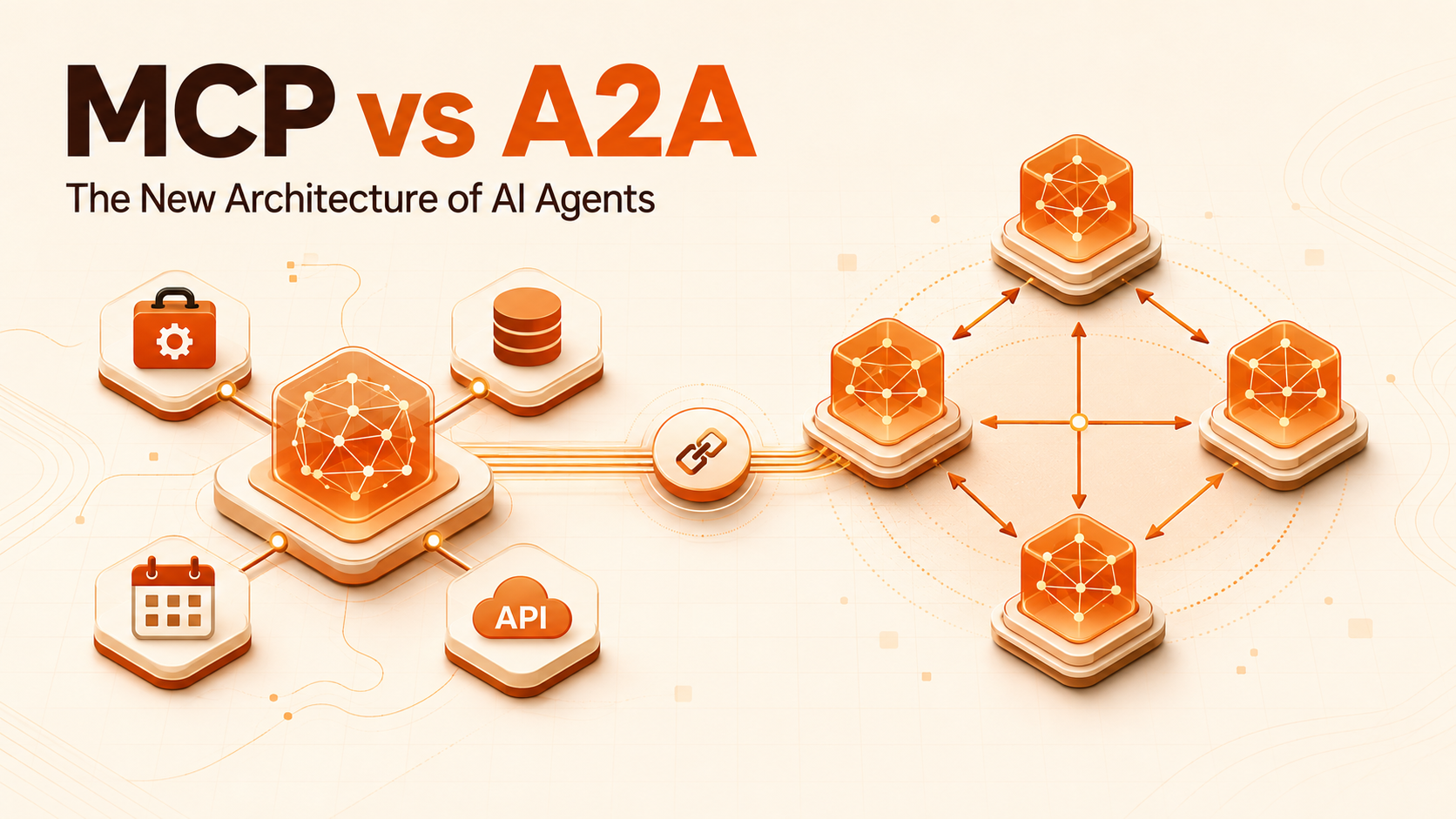
- Model Context Protocol (MCP): Connects AI agents to tools, applications and data.
- Agent2Agent Protocol (A2A): Enables independent AI agents to discover, communicate and collaborate with each other.
MCP and A2A are not competing technologies. They solve different problems and can work together inside the same AI product.
What Is the Model Context Protocol?
The Model Context Protocol, commonly called MCP, provides a standardized way for AI applications to access external tools and contextual information.
Without MCP, developers usually create separate integrations for every service an AI agent needs to use. A CRM integration may require one custom connector, Google Calendar another, and an internal database yet another.
This creates duplicated integration logic and makes the system increasingly difficult to maintain.
MCP introduces a shared interface between an AI application and external capabilities.
An MCP server can expose:
- Tools that an agent can execute
- Business data and contextual resources
- Reusable prompt templates
- Structured descriptions of available capabilities
For example, a clinic-management MCP server could expose tools such as:
check_available_slotsbook_appointmentfind_patient_recordsend_appointment_reminderupdate_lead_status
The AI agent does not need to understand the internal implementation of the clinic’s database or scheduling platform. It only needs to understand the tools and schemas exposed by the MCP server.
A simple MCP workflow
Consider an AI receptionist handling an appointment request:
-
A patient asks for an appointment on Monday evening.
-
The AI agent understands the request.
-
It calls the scheduling tool exposed through MCP.
-
The scheduling system returns the available slots.
-
The agent presents suitable options to the patient.
-
After confirmation, it calls the booking tool.
-
The appointment is saved and a confirmation is sent.
In this workflow, the agent handles language and decision-making, while MCP provides standardized access to the business systems.
What Is the Agent2Agent Protocol?
The Agent2Agent Protocol, or A2A, focuses on communication between independent AI agents.
A2A was introduced to help agents built with different models, frameworks and programming languages work together through a common communication standard.
Instead of exposing a basic function, an A2A-compatible agent can describe:
- Its identity
- Its capabilities
- The tasks it can perform
- How another agent can communicate with it
- The status and results of delegated tasks
An A2A agent publishes an Agent Card containing this information. Other agents can use the card to discover what the agent does and determine whether it can handle a particular task.
Google describes A2A as an open standard for agent interoperability across languages and frameworks. This makes it possible for a Python agent built using LangGraph to collaborate with an agent implemented in Java, JavaScript or another supported environment.
A simple A2A workflow
Imagine a healthcare business using three specialized agents:
- A receptionist agent handles patient conversations.
- A scheduling agent manages appointments.
- A billing agent manages payments and invoices.
When a patient asks to reschedule a paid appointment, the receptionist agent may:
-
Delegate the availability check to the scheduling agent.
-
Receive several suitable time slots.
-
Ask the patient to select one.
-
Delegate the rescheduling task to the scheduling agent.
-
Notify the billing agent if the appointment price changes.
-
Present the completed result to the patient.
Each agent owns a specific responsibility. A2A provides the communication layer through which these agents exchange tasks, progress updates and results.
MCP vs A2A
| Area | MCP | A2A |
| ----------------------- | ---------------------------------- | ------------------------------------------ |
| Primary purpose | Connect agents with tools and data | Connect agents with other agents |
| Communication | Agent-to-tool | Agent-to-agent |
| Typical capability | Query a database or update a CRM | Delegate a task to a specialized agent |
| Unit of interaction | Tool call or resource request | Task, message, status or artifact |
| Best suited for | Integrations and contextual access | Distributed multi-agent workflows |
| Example | Check available appointment slots | Ask a scheduling agent to manage a booking |
| Can they work together? | Yes | Yes |
The easiest way to understand the distinction is:
MCP gives an agent access to capabilities. A2A allows an agent to collaborate with another autonomous agent.
How MCP and A2A Work Together
A production AI system may use both protocols at different layers.
Consider an AI marketing platform for therapists and clinics.
The platform could contain:
- A campaign-planning agent
- A content-generation agent
- An advertising agent
- A lead-qualification agent
- A reporting agent
These agents could communicate through A2A. Each specialized agent could then use MCP to access the tools required for its own work.
For example:
-
The campaign agent creates a marketing strategy.
-
It delegates content production to the content agent through A2A.
-
The content agent uses MCP tools to access brand guidelines and previous campaigns.
-
The advertising agent uses MCP to connect with advertising platforms.
-
The lead agent uses MCP to update lead information in the CRM.
-
The reporting agent collects the results and prepares a performance summary.
In this architecture:
- A2A coordinates specialized intelligence.
- MCP connects that intelligence to real business systems.
Why Not Use Normal REST APIs for Everything?
REST APIs remain essential and will continue to power most software integrations. MCP and A2A do not eliminate them.
The difference lies in the interface designed for the AI layer.
Traditional APIs are built primarily for deterministic software. Developers usually know exactly which endpoint needs to be called, in what order and with which parameters.
AI agents operate more dynamically. They may need to:
- Discover capabilities during runtime
- Select between multiple tools
- Delegate open-ended tasks
- Track long-running operations
- Receive intermediate updates
- Exchange generated files or structured artifacts
MCP and A2A create standardized contracts around these agent-oriented interactions. The actual implementation underneath may still use REST APIs, databases, message queues and event-driven services.
Do You Need Multiple Agents?
Multi-agent architecture is powerful, but it is not automatically the right choice for every AI product.
A single agent with a few well-defined tools is often sufficient when:
- The workflow is short and predictable.
- All operations share the same context.
- There are only a few integrations.
- Tasks do not require separate ownership.
- Low latency and cost are priorities.
Multiple agents become more useful when:
- Different tasks require specialized instructions or models.
- Teams independently own different capabilities.
- A workflow crosses multiple products or organizations.
- Tasks run asynchronously or take a long time.
- Security boundaries require agents to have different permissions.
- The system needs to scale individual capabilities independently.
Adding more agents also introduces additional latency, cost, observability requirements and failure points. Therefore, teams should start with the smallest architecture capable of solving the business problem.
A Practical Production Architecture
A production-ready MCP and A2A system requires more than an LLM and a collection of prompts.
A reliable architecture may include:
- FastAPI or Node.js for application APIs
- LangGraph or an Agents SDK for agent orchestration
- PostgreSQL for users, tasks and business records
- pgvector or Qdrant for semantic retrieval
- Redis or Valkey for caching and short-lived state
- Celery or another queue system for background tasks
- MCP servers for tools and contextual resources
- A2A services for collaboration between specialized agents
- Tracing and evaluation tools for monitoring performance
A typical request might move through the system like this:
-
The application receives a user request.
-
The orchestrator identifies the required capability.
-
A specialized agent receives the task through A2A.
-
That agent uses MCP to access an approved business tool.
-
The action executes through the appropriate backend service.
-
The system stores the task result and audit trail.
-
The final response returns to the user.
Every important step should be observable, resumable and protected by appropriate permissions.
Security Cannot Be an Afterthought
Once an AI agent can perform real actions, prompt quality is no longer the only concern.
The system must determine:
- Which user authorized the action?
- What data can the agent access?
- Which tools can it execute?
- Does the action require confirmation?
- Can sensitive information leave the organization?
- Is there a record of what the agent did?
- Can a failed or harmful action be reversed?
Production systems should use:
- User-scoped authentication
- Tool-level permissions
- Short-lived access tokens
- Input and output validation
- Human approval for sensitive actions
- Complete audit logs
- Rate limits and cost limits
- Sandboxed execution environments
- Idempotency protection for repeated requests
An agent that can read appointment availability should not automatically receive permission to access complete medical records. Similarly, an advertising agent should not be allowed to increase campaign budgets without an approval policy.
The reasoning layer and the action layer should remain separately controlled.
Common Mistakes When Building Agentic Products
1. Turning every function into an agent
A deterministic calculation, database query or validation rule usually belongs in normal application code. AI should be used where language understanding, reasoning or flexible decision-making adds meaningful value.
2. Starting with too many agents
A complex multi-agent design may look impressive while making debugging significantly harder. Begin with one agent and clearly defined tools. Add specialized agents only when the product genuinely needs independent responsibilities.
3. Giving agents excessive permissions
An agent should receive the minimum access required to complete its task. Broad credentials create unnecessary security and operational risk.
4. Ignoring evaluation
A workflow working successfully once does not make it reliable. Teams need test datasets that measure tool selection, task completion, factual accuracy, latency, cost and policy compliance.
5. Building without a measurable business outcome
An AI agent should improve a real metric, such as:
- Appointments booked
- Leads qualified
- Response time reduced
- Support tickets resolved
- Content-production time saved
- Advertising cost reduced
- Revenue recovered from missed calls
The most sophisticated architecture has little value if it does not improve a meaningful outcome.
The Future of AI SaaS Is Interoperable
AI products are moving from isolated assistants toward connected systems that can understand requests, use tools and coordinate work across services.
MCP provides a common method for connecting agents to external capabilities. A2A provides a common method for agents to discover and collaborate with each other.
Together, they establish an important foundation for building interoperable AI products.
However, adopting these protocols does not automatically make a system intelligent, secure or valuable. Successful products will still require:
- A clearly defined business problem
- Reliable backend engineering
- Carefully scoped permissions
- Human oversight
- Continuous evaluation
- Measurable return on investment
The winning AI SaaS products will not be the ones with the largest number of agents. They will be the ones that use the right amount of autonomy to solve a valuable problem reliably.
Build Production-Ready AI Products with Chaibytes
Chaibytes designs and develops AI SaaS products, intelligent workflows, voice agents, RAG systems and business automation platforms.
We focus on transforming an AI idea into a reliable product with real integrations, scalable backend infrastructure and measurable business value.
If you are planning an AI agent, vertical SaaS platform or automation product, connect with Chaibytes to discuss your MVP.
-
Meta title:* MCP vs A2A Protocol: AI Agent Communication in 2026
-
Meta description:* Learn the difference between MCP and A2A, how they work together, and how to build secure, production-ready AI-agent workflows for modern SaaS products.
-
Suggested URL slug:*
/blog/mcp-vs-a2a-ai-agent-protocols -
Primary keyword:* MCP vs A2A
-
Secondary keywords:* Model Context Protocol, Agent2Agent Protocol, AI agent communication, multi-agent architecture, AI SaaS development, agent interoperability
-
Suggested featured-image text:* MCP vs A2A: The New Architecture of AI Agents